The Deconstruction of Human Resources
Why HR's expanded mandate has not changed how the function is experienced
Years ago, I was asked to collect cell phones from a group of employees. The organization had decided that employees in certain job grades would no longer be issued company phones. Someone had to take them back and manage the employee responses, and HR became the "obvious choice." I remember thinking, why is this HR work?
The decision affected employees so it automatically became HR’s responsibility, and we became responsible for physically collecting the phones and managing the employee response. The assignment itself may seem small. However, the assumption behind it continues to shape how the function is perceived and included.
When work involves employees, especially work that is uncomfortable, administratively burdensome, or difficult to place, organizations often assign it to HR. Answers to questions about the administrative mindset of HR can be traced to such moments as the one I just shared. Talk to any HR professional who’s been in the game any length of time and they will have stories – tons of ‘em!
HR has changed some in the last thirty years. Its reputation has not.
In 1998 (which my 10-year-old son lovingly calls the 1900s), Dave Ulrich opened his Harvard Business Review article, "A New Mandate for Human Resources," by asking whether organizations should do away with HR. He pointed to widespread doubts about the function's contribution to organizational performance and argued that HR needed to have a much greater role in developing the organizational capabilities needed to win in a highly competitive environment.
Over the years, HR has experienced slight evolutions due to mandate expansion. Titles continue to change and the technology behind the work looks nothing like it did in 1998. Yet the criticisms of the function sound remarkably similar to the ones Ulrich referenced.
Research validates this. Deloitte's 2024 global study found only about one in seven executives strongly agree their organization values HR's work, and a 2023 systematic review covering more than 50 years of research on HR roles reached a similar conclusion. HR professionals have made significant efforts to move into more strategic roles, but the historical tensions surrounding the function remain.
There is real effort taking place inside of the function. However, the way forward requires HR professionals and organizational leaders to work on it together, because at the end of the day, the system is built in a way that keeps reproducing the same result. The deconstruction of HR is a necessary step in resetting the system. Unplug it and plug it back in.
I have spent more than 20 years working in and around the HR function. I have watched it evolve from personnel administration to human resources, people operations, employee experience, people and culture, and countless other variations. The language changed when the aspirations changed. However, organizations often layered those aspirations onto operating foundations that were not reset. Thus, the system gets what it is designed to get.
HR retained responsibility for compliance, policy, transactions, employee relations, case management, and administrative execution. Then organizations added talent management, leadership development, culture, engagement, organizational effectiveness, workforce planning, transformation, and employee experience. HR’s capacity, authority, operating model, and access to decision-making did not typically expand with it. This is where deconstruction comes in.
Deconstruction allows us to examine what has been normalized
Deconstruction is often misunderstood as destruction, or criticism for the sake of criticism. It is better understood as an examination of the assumptions, hierarchies, and oppositions that make a system appear natural and stable. It also reveals how one side of a paradox is treated as superior often leaving the other side subordinated. Through that lens, I share my assessment.
Applied to HR, deconstruction requires us to examine the beliefs that shape the function.
Why do organizations assume that work involving employees belongs to HR?
Why is business strategy developed first and people strategy created afterward?
Why is HR expected to operate strategically while its capacity remains consumed by operational demands?
Why does HR continue to measure completed activity when the organization wants evidence of value?
Why do employees believe HR protects the organization while some leaders believe HR is too closely connected to employees?
These questions reveal how HR is constructed and how the function continues to reproduce the reputation it continuously attempts to change. They also uncover the tensions that exist within the function which happen to be the same three tensions I regularly hear about in discussions with HR professionals and business leaders:
Employee advocacy or organizational protection: Whom does HR serve?
Strategy or administration: What work is HR expected and permitted to perform?
Value or activity: How is HR’s contribution defined and demonstrated?
Strategy and administration compete for the same capacity
Administrative work is necessary. Organizations need accurate records, sound policies, reliable processes, regulatory compliance, responsive employee relations, and consistent execution. Strategic HR cannot operate on top of administrative disorder. The problem begins when administration consumes the time, capacity, and attention needed for the function to operate at a different altitude.
HR professionals can spend entire days responding to cases, resolving immediate issues, answering questions, interpreting policies, correcting transactions, and completing work that other functions have passed to them. The work may be necessary, but the volume keeps the function in a reactive state. That reactive state limits HR's ability to:
identify patterns across the workforce;
anticipate changes in capability requirements;
assess whether the organization can deliver its strategy;
consider how economic, political, competitive, and geographic conditions may affect the workforce;
evaluate the organizational consequences of proposed decisions;
and design interventions for the people systems shaping business performance.
Research has documented this constraint. A study presented at a CIPD research conference found that HR professionals' ability to operate strategically depended partly on whether they had autonomy, time, and space to think. Participants also described how the weight of policy and process made strategic and creative contribution more difficult.
The deepest problem is not that HR has administrative work. It is that the volume and design of that work often keep the function in a reactive state, consuming the capacity required for the contribution organizations say they want.
Activity has become the easiest evidence of HR's contribution
HR usually has a long list of things to do. Positions must be filled. Cases must be resolved. Policies must be updated. Training must be delivered. Performance cycles must be completed. Surveys must be launched. Communications must be sent. These activities create visible evidence that the team is working. They do not always tell us whether the work produced value.
A completed leadership program does not tell us whether leaders became more effective. A filled vacancy does not tell us whether the organization hired the capability it needed. A completed reorganization does not tell us whether decisions move faster, ownership became clearer, or work flows more effectively.
HR has been told for decades to measure outcomes rather than activity. Yet activity remains easier to count, easier to report, and easier to connect to the requests the function receives. This also shapes how HR proves its usefulness. Too often, HR proves that it is helpful by accepting the work. Then the organization values HR primarily for its responsiveness to that work. Organizations cannot continually fill HR's capacity with work no one else wants to own and then question why HR is not shaping the work that matters most.
HR also has a responsibility here and must stop believing that accepting every request proves worth. There are times when being an effective partner requires HR to challenge the request, redefine the problem, or make the tradeoff visible. We can take on the work. We also need to be clear about what will be delayed or displaced as a result. And then there is the work that needs to be done to implement and effectively utilize artificial intelligence and automation, but I will save that for another think piece.
Employee advocacy and organizational protection are treated as opposing loyalties
Employees often believe HR exists to protect the organization. Some leaders believe HR professionals are too closely connected to employees and fail to appreciate the realities of operating the business. HR stands between these perceptions and is expected to maintain credibility with both groups. My, what a thin tightrope!
This tension is real because HR is employed by the organization. It has responsibilities involving legal risk, policy, organizational interests, and business continuity. HR also has a responsibility to surface employee concerns, advocate for equitable treatment, and explain how organizational decisions may affect the workforce. And through all this, HR still needs to focus on developing strategies that drive business results.
Advocating for employees does protect the business. When HR challenges inconsistent treatment, poor leadership behavior, unreasonable workloads, or decisions that damage trust, it is addressing conditions that can affect retention, performance, risk, reputation, and the organization's ability to deliver results. Organizational protection and employee advocacy do not have to operate as competing loyalties. Both require HR to provide leaders with clear information about what is happening inside the organization and what their decisions may produce.
The problem is not that HR must choose between employee advocacy and organizational protection, strategy and administration, or activity and value. The problem is that organizations continue to treat these dimensions as polar opposites while HR continues to operate within structures that privilege protection, administration, and activity. It is no wonder, then, that the function is not experienced as strategic, valuable, or meaningfully connected to either employees or the business.
The current system continues to regenerate the same version of HR
I believe systems produce the outcomes they are designed to produce, including outcomes no one intended. HR's current reputation is sustained through a reinforcing cycle.
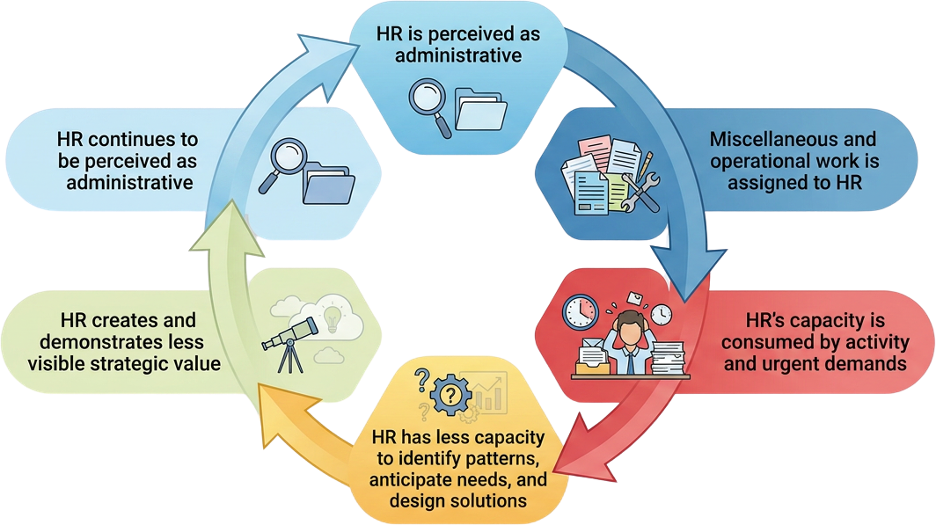
The Administration Perception Loop
The system reinforces itself. No one leader has to decide that HR should remain tactical. No HR professional has to decide that the function should remain reactive. The combined expectations, work assignments, measures, relationships, and operating habits continue producing that result. This is why telling HR professionals to be “more strategic” has had limited effect.
Individual capability matters, but the organizational environment matters too. Research on the strategic effectiveness of HR professionals has found that competencies and organizational barriers require equal attention. An HR professional can understand the business, develop sound judgment, and strengthen their strategic capability while working inside a structure that restricts access, autonomy, information, and influence. The function cannot change through competency development alone.
People strategy is business strategy
Organizations often develop the business strategy and then ask HR to create the people strategy required to enable it. That sequence separates two things that do not exist separately. Every major business decision contains choices and assumptions about people. Therefore, HR must be along for the entirety of the ride – not picked up along the way.
A growth strategy carries assumptions about the capabilities the organization will need. A cost-reduction strategy affects workload, leadership, trust, decision-making, and organizational capacity. A merger requires decisions about structure, authority, culture, talent, systems, and how work will move across the new organization. A market expansion depends on available skills, leadership readiness, labor conditions, local expectations, and the organization's ability to operate in a new environment.
People strategy should not be created as a separate response after business leaders have decided what the organization will do. This is why I want to push the conversation further than saying HR should be brought in earlier. Why was someone with a strong HR and organizational perspective not part of the conversation when the idea first surfaced? Forget a seat at the table, we should be drafting the blueprint for the new table we’re building together.
HR should not be invited to a decision simply because it involves employees. That would reinforce the assumption that everything involving people belongs to HR. HR should be included in business decisions because the right partner can strengthen how leaders define the problem, assess the available options, anticipate consequences, and determine what the organization needs to deliver what is being proposed.
But that place must be earned. The HR partner must understand the business, the industry, the workforce, the broader environment, and the operational realities of the organization. They need the judgment to understand what matters, the evidence to make a credible case, and the confidence to challenge leaders when the proposed direction creates risks or overlooks better alternatives. Having HR present does not guarantee a better decision. The capability of the person in the role matters.
Credibility and access reinforce one another
HR professionals are often told they must earn the credibility required to participate in strategic decision-making. I agree. A title does not automatically make someone a trusted advisor. Business leaders need confidence that their HR partner understands how the organization creates value, serves customers, competes, makes money, allocates resources, and measures performance. However, credibility presents another reinforcing cycle.
Credibility and access reinforce one another. When HR has a seat at the table early, it can shape decisions. When HR enters late, it inherits decisions made without the perspective that might have improved them. Leaders make the decision and invite HR to execute it. HR's visible contribution becomes implementation, administration, and damage control. HR continues to be perceived primarily as an execution function. Credibility is treated as the price of admission, even though admission is one of the places credibility is built.

The Credibility Catch-22
When HR joins late, it manages consequences that might have been anticipated
I once worked through an organizational transformation that would result in a significant number of layoffs. The financial modeling had been completed and the general direction had been agreed upon. By the time HR became deeply involved, the work had moved into a hurry-up offense focused on implementation.
There had been limited consideration of the vacancies the new structure would create. The organization had not fully evaluated skill-based placements, internal mobility, or whether some affected employees could move into work the business still needed. HR now had to process a reduction rather than partner in shaping the transformation.
Earlier participation would have opened the door for the following questions to be answered:
What capabilities will the future organization require?
Which of those capabilities already exist inside the company?
What current or anticipated vacancies could be filled through internal placement?
Which employees have transferable skills that may not be visible from their current titles?
What institutional knowledge would leave with the eliminated positions?
How would the proposed structure affect workload and decision-making?
What would the organization need from leaders during and after the transition?
What would severance, recruiting, onboarding, lost productivity, and time to fill cost compared with redeployment?
Could a different organizational design produce the required financial outcome with less disruption?
I cannot say with certainty that the final decision would have changed. I can say that the decision would have been better informed and that the execution and change management would have been more effective.
Recent research on restructuring reinforces the need for these questions. A 2026 LHH study of 3,000 HR leaders and more than 8,000 employees found substantial gaps in how organizations use and measure redeployment. Among the employers that tracked rehiring costs, nearly three in four acknowledged that rehiring cost more than targeted redeployment and mobility.
The organization in my example did not need HR only to implement a layoff. It needed an organizational perspective capable of challenging whether the proposed workforce changes represented the strongest way to achieve the business objective. When HR participates from the onset, it can influence the design of the decision. When HR is invited after the decision has hardened, it is usually left to manage the consequences.
The word strategic needs a more demanding definition
The word strategic appears in job titles, team objectives, development plans, and presentations across the HR profession. Its frequent use has diluted its meaning. And simply understanding elements of business does not a strategic HR professional make.
I define strategic HR this way:
“Strategic HR is the disciplined practice of partnering with leaders to diagnose the organization, design and implement its strategies, and measure the value produced. The practice demands both capability and contextual knowledge.”
This work requires a firm understanding of the company, industry, competition, labor market, economic conditions, political environment, technology, geography, and social changes that may affect the organization and workforce.
Strategic HR becomes observable when the function changes:
the questions leaders ask;
the alternatives they consider;
the risks and consequences they recognize;
the decisions they make;
and the organization's ability to deliver those decisions.
Strategic capability and strategic access are related, but they are not interchangeable. An HR professional may possess the capability and lack access to the conversations where it could be used. Another may receive access but offer little beyond traditional HR activity. It is the responsibility of HR leaders to ensure the right capabilities are appropriately positioned if any meaningful shifts are to happen for the function.
Did HR improve how the issue was understood? Did the function introduce information that changed the available options? Did it identify organizational consequences before the decision became difficult to change? Did its involvement improve the quality, feasibility, or implementation of the decision? Then comes effectiveness. What changed because HR contributed?
Reconstruction requires changes from HR and the organization
The continued evolution of HR requires more than another operating model or title change. HR professionals must develop the capability to contribute differently. That includes understanding the business beyond the boundaries of the company. It requires stronger external awareness, workforce knowledge, technological capabilities, organizational judgment, and the confidence to challenge requests that do not represent the best use of the function.
Leaders and organizations must reconsider their role as well. They need to be open to the examination of work assigned to HR on default, what belongs with managers, what belongs in operations, and what should be embedded throughout the organization. Employee engagement provides a good example. HR may administer the survey, analyze the results, and equip leaders with useful information, but the daily conditions affecting engagement remain the responsibility of leaders across the organization.
The same is true of culture. Culture cannot be HR's responsibility simply because HR owns some of the tools used to assess or influence it. Leaders shape employees' daily experiences in a number of ways and should feel a stronger sense of ownership over the culture of the organization.
AI also creates a meaningful opportunity, but only if HR uses the capacity it creates intentionally. AI can reduce time spent drafting routine communications, synthesizing information, answering common questions, completing transactions, and analyzing data. SHRM's 2026 research shows adoption gathering pace, with nearly half of organizations expecting to use AI in their HR function this year. Faster administration alone will not reposition the function.
As AI releases capacity, HR must be intentional with the reclaimed time. Without a deliberate change in priorities, the space will be filled with more requests and more activity. The recovered time should be invested in diagnosis, organizational planning, workforce foresight, leadership effectiveness, decision quality, and the business challenges where HR can produce greater value.
HR professionals must decide what part they will play
After reading this, I want HR professionals to reflect on the role they currently play and where they want their careers to go. Consider these questions:
What work consumes most of my capacity?
Which activities are necessary, and which have been assigned to HR by organizational habit?
What do I know about my business, industry, workforce, customers, competitors, and external environment?
Which major decisions am I invited to influence while they are still being formed?
What perspective do I bring that improves those decisions?
Can I explain the value of the work I complete?
What part do I want to play in the legacy and continued evolution of the HR function?
HR professionals did not create every condition that keeps the function administratively trapped. However, we still have choices about how we approach and measure the value of the work.
For 30 years, organizations have expanded HR's responsibilities while continuing to question its value. HR professionals have pursued strategic credibility while continuing to operate inside systems that prioritize administration and activity. Until HR and business leaders work together to dismantle and rebuild the system, the reputation of the function will likely remain unchanged.
About the author
Dr. Quennette Taylor is the Founder of Taylor Made Global Consulting, a boutique organizational strategy and effectiveness firm that closes the gap between what an organization's strategy requires and what its people and systems can actually deliver. She brings more than 20 years of experience inside Fortune 100 organizations and holds a Ph.D. in Global Leadership and Change from Pepperdine University.
References
Allen, K. S. (2017). Beyond HR competencies: Removing organizational barriers to maximize the strategic effectiveness of HR professionals. Industrial and Organizational Psychology, 10(1). https://www.cambridge.org/core/journals/industrial-and-organizational-psychology/article/abs/beyond-hr-competencies-removing-organizational-barriers-to-maximize-the-strategic-effectiveness-of-hr-professionals/B890C685CD10DE655D04951CDCE8F8C3
Cayrat, C., & Boxall, P. (2023). The roles of the HR function: A systematic review of tensions, continuity and change. Human Resource Management Review, 33(4), Article 100984. https://www.sciencedirect.com/science/article/pii/S1053482223000372
Delany, K., & Tregaskis, O. (2018). The building blocks for a ‘more strategic’ role for HR [Conference paper]. CIPD Applied Research Conference. https://www.cipd.org/globalassets/media/comms/get-involved/events/strategic-role-hr_tcm18-59084.pdf
Deloitte. (2024). 2024 global human capital trends: Thriving beyond boundaries. Deloitte Insights. https://www.deloitte.com/us/en/insights/topics/talent/human-capital-trends.html
LHH. (2026). 2026 career redeployment and outplacement trends report. https://www.lhh.com/en-us/insights/pressroom/lhh-research-reveals-2026-layoff-trends
SHRM. (2026). The state of AI in HR 2026. https://www.shrm.org/topics-tools/research/state-of-ai-hr-2026/full-report
Ulrich, D. (1998). A new mandate for human resources. Harvard Business Review, 76(1). https://hbr.org/1998/01/a-new-mandate-for-human-resources